Female Empowerment Programs for Perth Schools and WA Community Groups
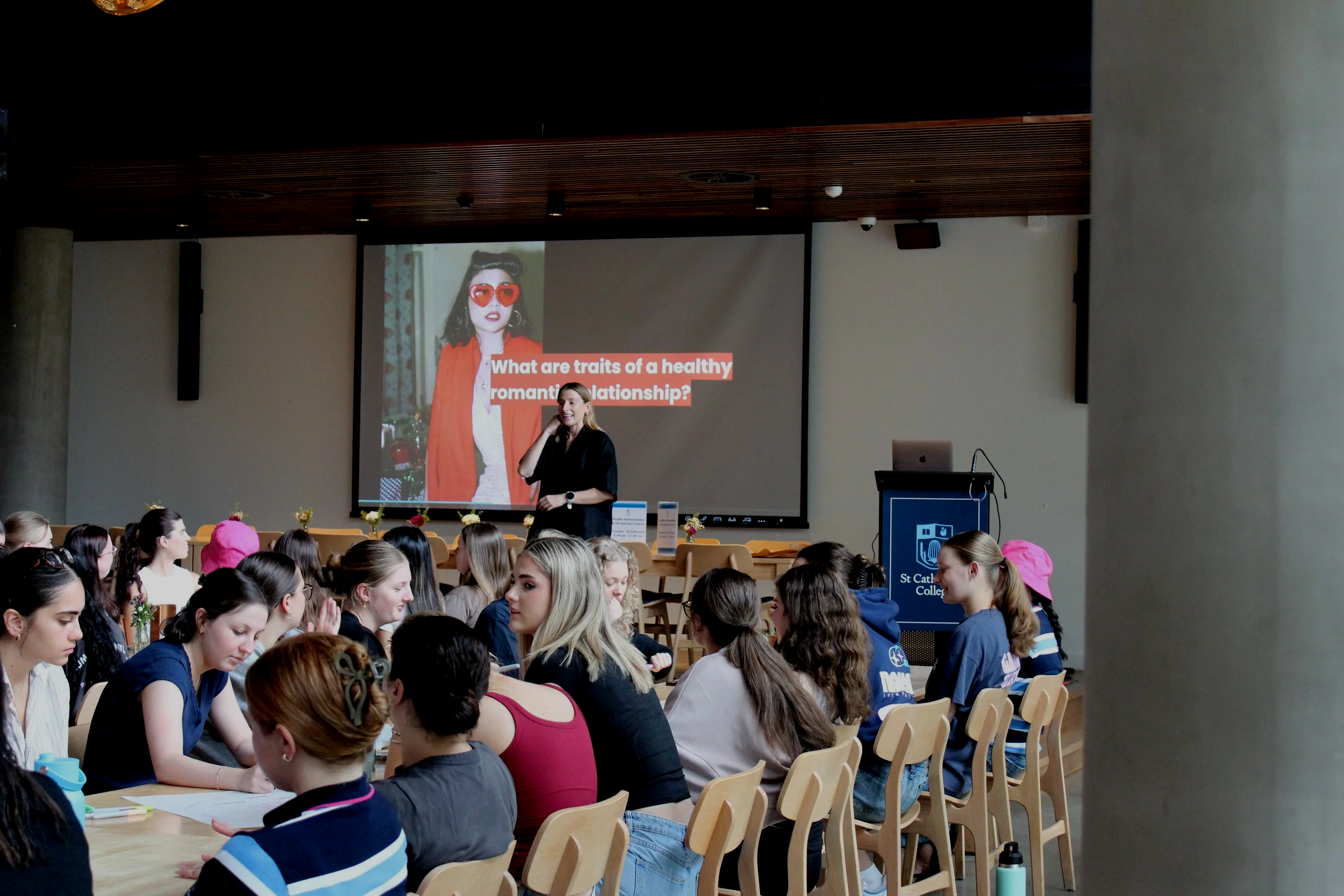
Suite 3 is designed for female-identifying young people who are navigating a world that constantly tries to tell them who they should be, what they should look like, how much space they're allowed to take up, and what they're permitted to feel.
These three sessions create a space - honest, safe, and without judgement - where young women can examine the forces shaping their lives and build the confidence, critical thinking, and solidarity to push back.
Each session can be booked individually - no need to complete the full suite. Sessions are designed to build on each other but work equally well as standalone programs.
Session A - Social Media Influence
Social media is not a neutral space. It is an engineered environment designed to capture attention, hold it, and profit from it, and the way it does that has a measurable impact on how young women see themselves, their bodies, their relationships, and their worth. This session gives participants the tools to understand the machine, and in doing so, take back some of its power.
-
Understanding how recommendation systems decide what content reaches you - prioritising emotional reaction, engagement, and outrage over accuracy or wellbeing. Participants learn to see their feed as a curated commercial product, not a neutral reflection of reality.
-
How algorithmic personalisation creates increasingly narrow information environments - and how that affects beliefs about beauty, relationships, gender, and social norms. Includes the December 2025 social media age restriction changes and what they mean in practice.
-
The documented links between social media use and body image, self-esteem, and mental wellbeing - explored not to frighten, but to name what many participants are already experiencing and give them language for it. Covers how influencer culture specifically monetises insecurity.
-
Managing inappropriate messages, understanding digital footprints, and knowing your rights in online spaces. Practical strategies for protecting yourself without withdrawing from digital life entirely.
-
How online content shapes gender expectations - the narrow, often contradictory standards applied to young women - and building the critical media literacy skills to identify and push back on those narratives rather than internalise them.
-
Suggested for Years 9–12
An excellent entry point for groups who may not have covered online safety or media literacy in depth before.
Session B - Standing Up & Standing Together
Most young women know when something feels wrong. The harder part is knowing what to do about it - especially when the pressure to stay quiet, keep the peace, and not make things awkward is constant and comes from every direction. This session is about closing that gap between knowing and acting.
-
Building a shared vocabulary for harm - from everyday sexism and dismissive comments through to more serious misconduct. Participants learn that you cannot effectively challenge what you cannot clearly name, and that naming something is itself an act of resistance.
-
Practical frameworks for responding in the moment - what to say, how to say it, and how to do it without escalating the situation or putting yourself at risk. Covers the difference between calling out and calling in, and why the latter is often more powerful and more sustainable.
-
How to support a friend who has experienced harassment or assault - what they actually need from you, the things people say with good intentions that make it worse, and how to help them access support without taking over their experience or their decisions.
-
What it means to build a culture where women genuinely look out for each other - and why the world benefits when they do not compete in the way they are told they should. Moves from individual resilience to collective action as the more powerful and sustainable model.
-
Practical knowledge of the support options available - school wellbeing teams, community services, reporting pathways - and how to access them for yourself or on behalf of a friend. Reduces the barrier between recognising a problem and doing something about it.
-
Suggested for Years 9–12
Works particularly well delivered alongside or after Session A, and pairs powerfully with the Consent Deep Dive from Suite 1.
Session C - Female Empowerment
This session is about identity - who you are, who you've been told to be, and the gap between those two things. It creates space for young women to examine what womanhood means to them on their own terms, build real confidence and resilience, and understand empowerment not as a feeling but as a practice.
-
What does it mean to be a woman: not what it's supposed to mean, not what participants have been told, but what they actually believe when given the space to think it through without noise. Explores how definitions of womanhood are contested, constructed, and constantly evolving, and why that matters.
-
Relationships between women and girls that should be sources of support and safety but have instead become sites of competition, exclusion, criticism, or control. These dynamics are common, painful, and almost never talked about honestly. Participants learn to recognise the patterns, understand why they develop, and move beyond them without guilt.
-
Not as personality traits you either have or don't - but as skills that can be practised and developed. How to assert boundaries without apologising for them. How to take up space without shrinking to make others comfortable. How to speak, disagree, lead, and be wrong in ways that don't erode your sense of self.
-
How to be present with difficulty - your own and others' - without immediately trying to fix it, minimise it, or make everyone else feel better at your own expense. A practical and emotionally grounded section that gives participants permission to feel hard things without being overwhelmed by them.
-
Empowerment that only flows inward is confidence. Empowerment that flows outward is power. Participants explore the concrete, everyday practices that lift up the women and girls around them - and understand why that collective investment changes the culture, not just the individual.
-
Suggested for Years 9–12
A powerful standalone session. Works beautifully as the closing program in the full Suite 3 sequence, but equally effective on its own for any female-identifying cohort.
-
Edwards et al. (2019); Miller et al. (2012); McCook (2022); Brookes (2023); UWA Power & Perception Research Project (2026)
"99% of students left our programs with a greater understanding of the topics. 100% of teachers asked us to return. We Are W/M create a space where young women feel genuinely heard - and leave feeling genuinely stronger."
— Aggregated feedback across WA school programs, 2025, and school wellbeing staff